We both slept incredibly well after checking in to the Marriott Mena House in Giza. After more than 24 hours of travel, that bed felt like a gift.
Coming from Canberra, most of our exposure to the Middle East comes through screens. News bulletins. Headlines. Commentary. Being here, in a country adjacent to active conflict zones, makes the complexity of everyday life immediately real.
Security is everywhere. Even at the hotel our vehicle was stopped, searched, and inspected with mirrors placed underneath. As we headed out this morning for breakfast near the Giza Plateau, we passed through multiple checkpoints again. Vans checked. Bags inspected. Armed security visible. Guards carrying long firearms. It’s not threatening, but it’s constant, and it’s part of daily life here.
Our host for the day was Amira, the sister of Mo, who has organised our private touring for these first few days. Today’s first experience was something special.
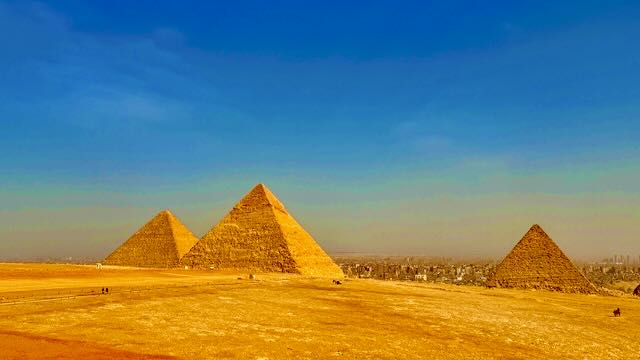
We started with breakfast at a rooftop restaurant overlooking the Giza Plateau, with a clear, uninterrupted view of the three great pyramids and the Sphinx.
Breakfast with the Pyramids
From left to right
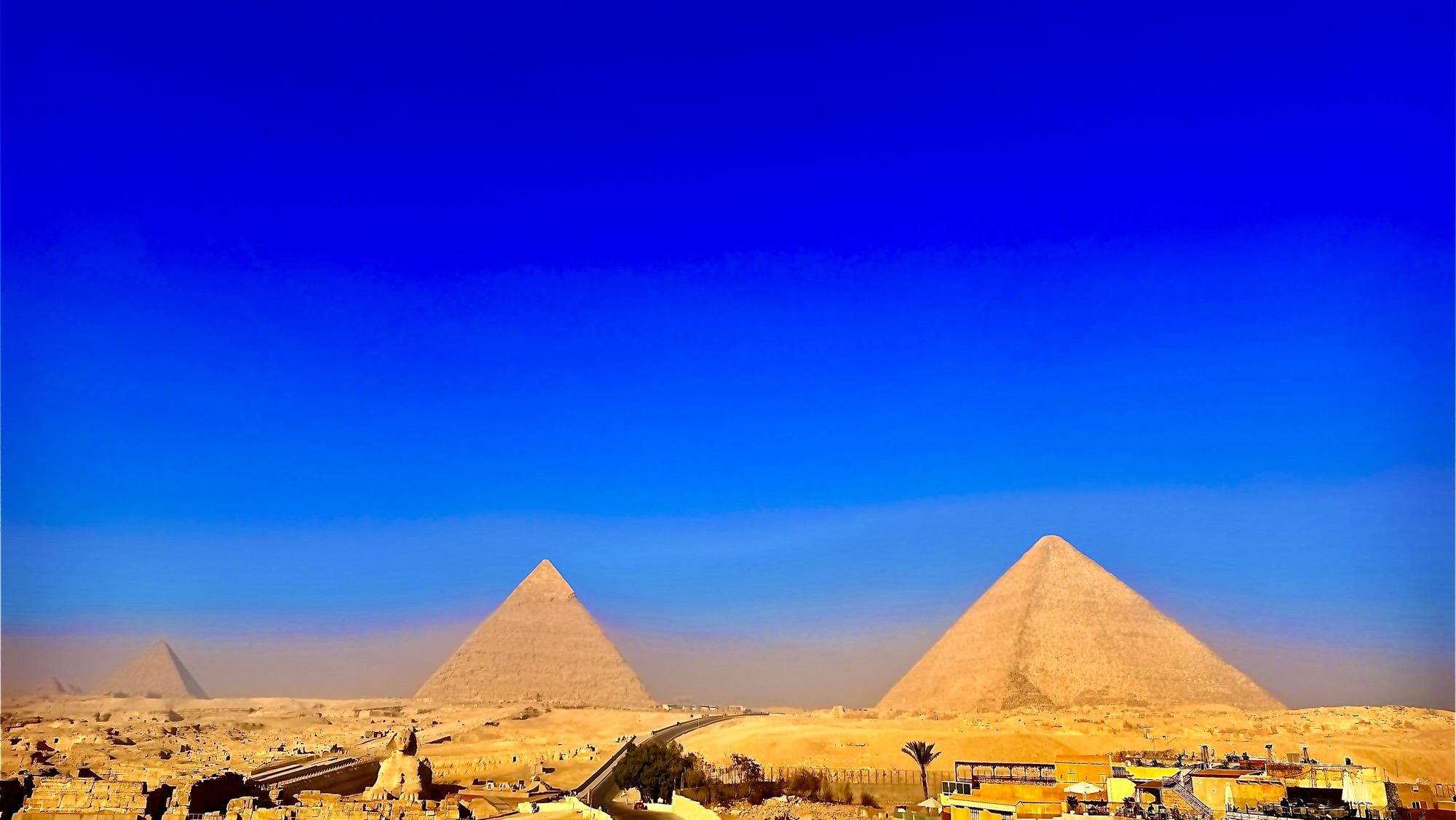
The Pyramid of Menkaure The Pyramid of Khafre The Great Pyramid of Khufu (Cheops)
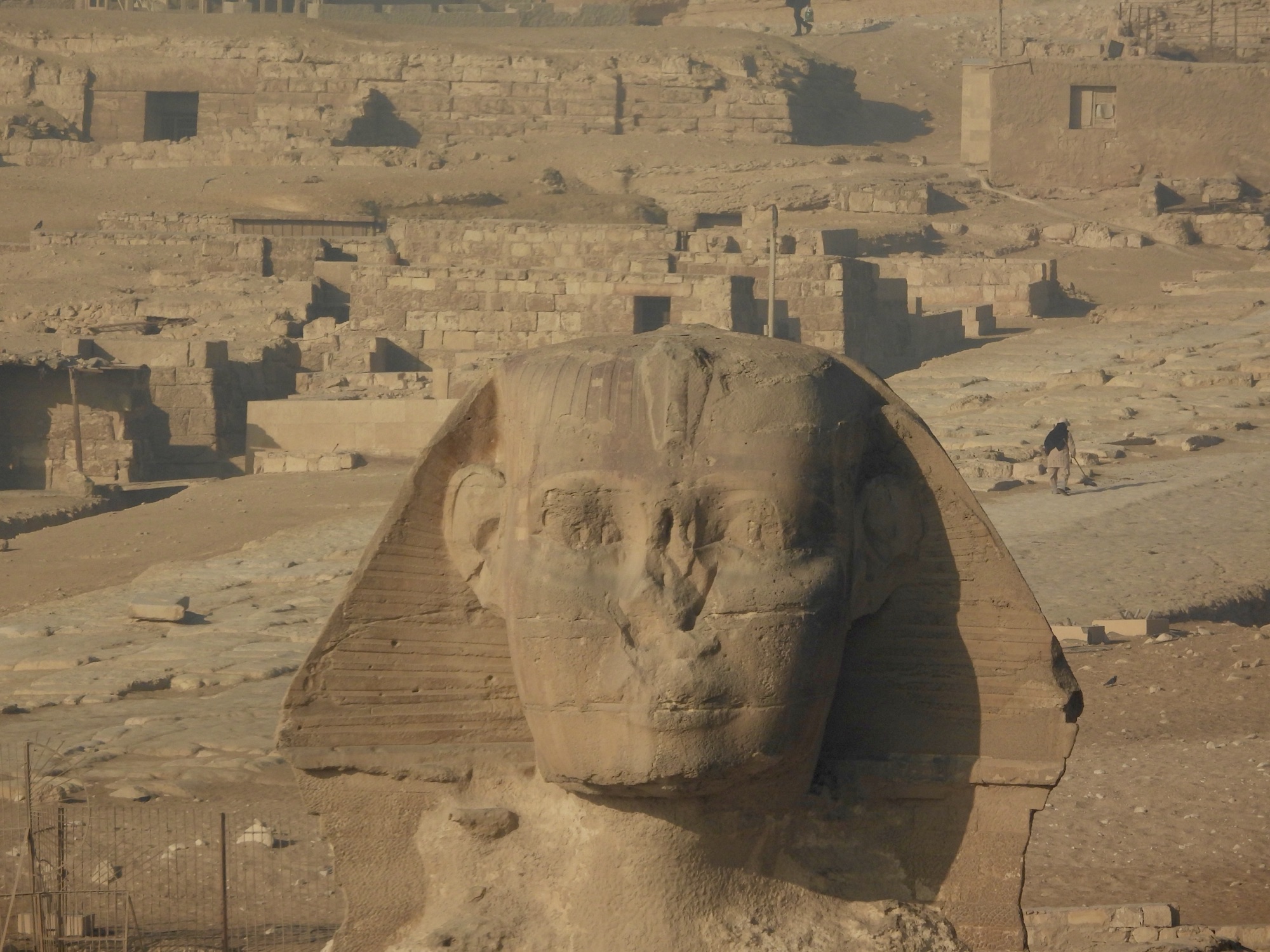
And nearby, the Great Sphinx of Giza, watching silently, as it has for millennia.
I wasn’t prepared for the emotional impact. Seeing the pyramids for the first time was overwhelming. Not just the scale, but the weight of time. These structures have stood for around 4,500 years, witnessing the rise and fall of civilisations, empires, religions, and entire ways of life.
It literally took my breath away.
I found myself unexpectedly emotional. Not sadness. Not joy alone. Not awe alone. But a powerful mix of elation, admiration, gratitude, and raw adrenaline. Gratitude to my wife for bringing me here for my 60th birthday. Gratitude to my brother David and Kerrie for joining us on what feels very much like a pilgrimage.
I’m not religious. I wouldn’t describe myself as particularly spiritual either. And yet, my whole life I’ve felt a pull toward Egypt. A fascination with its mythology, its architecture, its symbolism. I can’t fully explain it. Perhaps my long-standing love of Pink Floyd nudged the door open years ago. Whatever the reason, standing there, that feeling finally made sense.
The pyramids didn’t feel real. They looked almost suspended in front of us, as though they were part of a set rather than the physical world. In contrast, the streets of Cairo stretched out below us. Dense, chaotic, weathered buildings, each with rooftop platforms like the one we stood on.
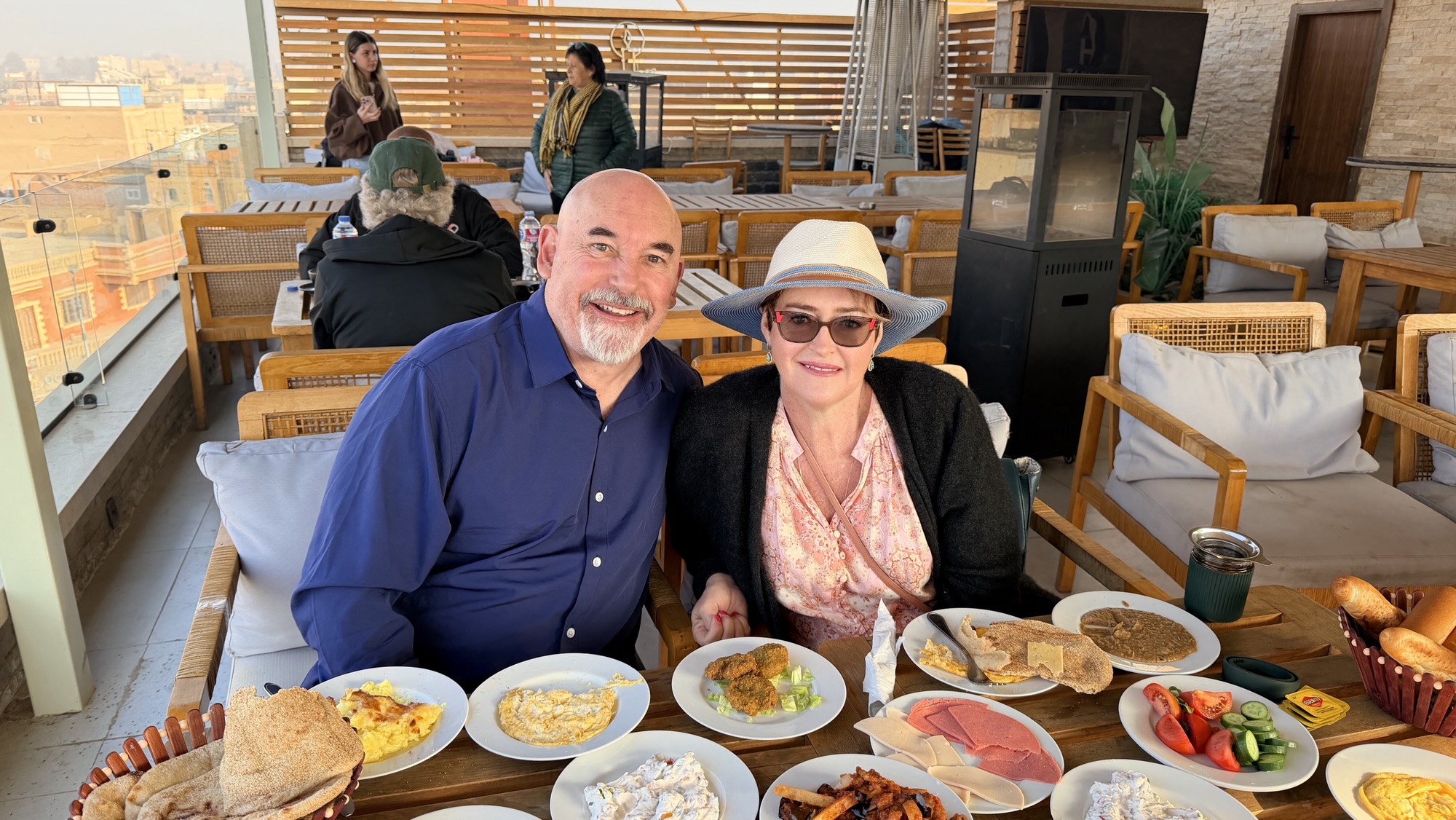
Breakfast was laid out in front of us. Potatoes, fried fava beans (ful medames), cheese, flatbread, assorted dips. Traditional Egyptian food. Simple and generous. We could have been anywhere.
And then you look up.
And the pyramids are just there.

Towering over everything. Keeping watch. As they’ve done for thousands of years.
During breakfast, Amira added another layer of meaning to the moment by explaining how names were written in ancient Egyptian hieroglyphs and enclosed within a cartouche. A cartouche is an oval or elongated loop with a line at one end, used in ancient Egypt to surround and protect a name. Traditionally, cartouches were reserved for the names of pharaohs and royalty, symbolising eternal protection and significance in both this life and the afterlife. Seeing our modern names interpreted through such an ancient lens felt unexpectedly intimate.
Amira talked us through each of our names, letter by letter, explaining the hieroglyphs that best represented their sounds rather than their spelling. Egyptian hieroglyphs weren’t an alphabet in the modern sense. They were a combination of symbols representing sounds, objects, and ideas. Some hieroglyphs stood for single consonant sounds, others for pairs or groups of sounds, and many also carried symbolic meaning. As Amira described the hieroglyphs used to represent Kerrie, David, Mardi and Michael she explained how animals, tools, and natural forms were chosen to approximate each sound. Listening to our names translated into symbols that are thousands of years old, while sitting in the shadow of the pyramids, was quietly powerful. It felt like a small bridge between the modern world and an ancient civilisation that still speaks, if you know how to listen.
The pyramids were built during Egypt’s Old Kingdom, around 2600–2500 BCE, primarily during the Fourth Dynasty. Pharaohs such as Khufu, Khafre, and Menkaure ruled during this time, commissioning monumental tombs designed to ensure their passage into the afterlife.
Across roughly 30 dynasties, Egypt evolved through the Old Kingdom, Middle Kingdom, and New Kingdom, producing some of history’s most recognisable rulers, including Hatshepsut, Thutmose III, Akhenaten, Tutankhamun, and Ramesses II.
Egypt later fell under foreign rule, including the Persians, then the Greeks after Alexander the Great, followed by the Roman period, beginning around 30 BCE. Each era left layers of culture, architecture, and belief that still coexist today.
Standing at Giza, you’re not just seeing one moment in time. You’re standing at the intersection of almost five millennia of human history.
Into the desert: Fayoum and Whale Valley
After breakfast, we set off on a two-hour drive southwest toward the Fayoum Oasis.
We passed through multiple checkpoints again, then out into open desert. Sand stretching in every direction. Eventually, we reached Lake Qarun, a vast saltwater lake fed by Nile channels and balanced by salt flats to the west.
From there, we switched vehicles, leaving our minivan behind and climbing into a 4WD. This was where the real off-road adventure began.
Our driver, Mustafa, was exceptional. No roads. No signs. No visible landmarks. Just desert. Sand and sky. He navigated confidently for about an hour until we reached Wadi Al-Hitan, known as Whale Valley.
This is a UNESCO World Heritage Site, discovered in the late 19th century, where the desert once lay beneath a vast prehistoric ocean. Embedded in the sand are complete fossilised whale skeletons, some stretching 20 to 30 metres long, preserved exactly where they were found.
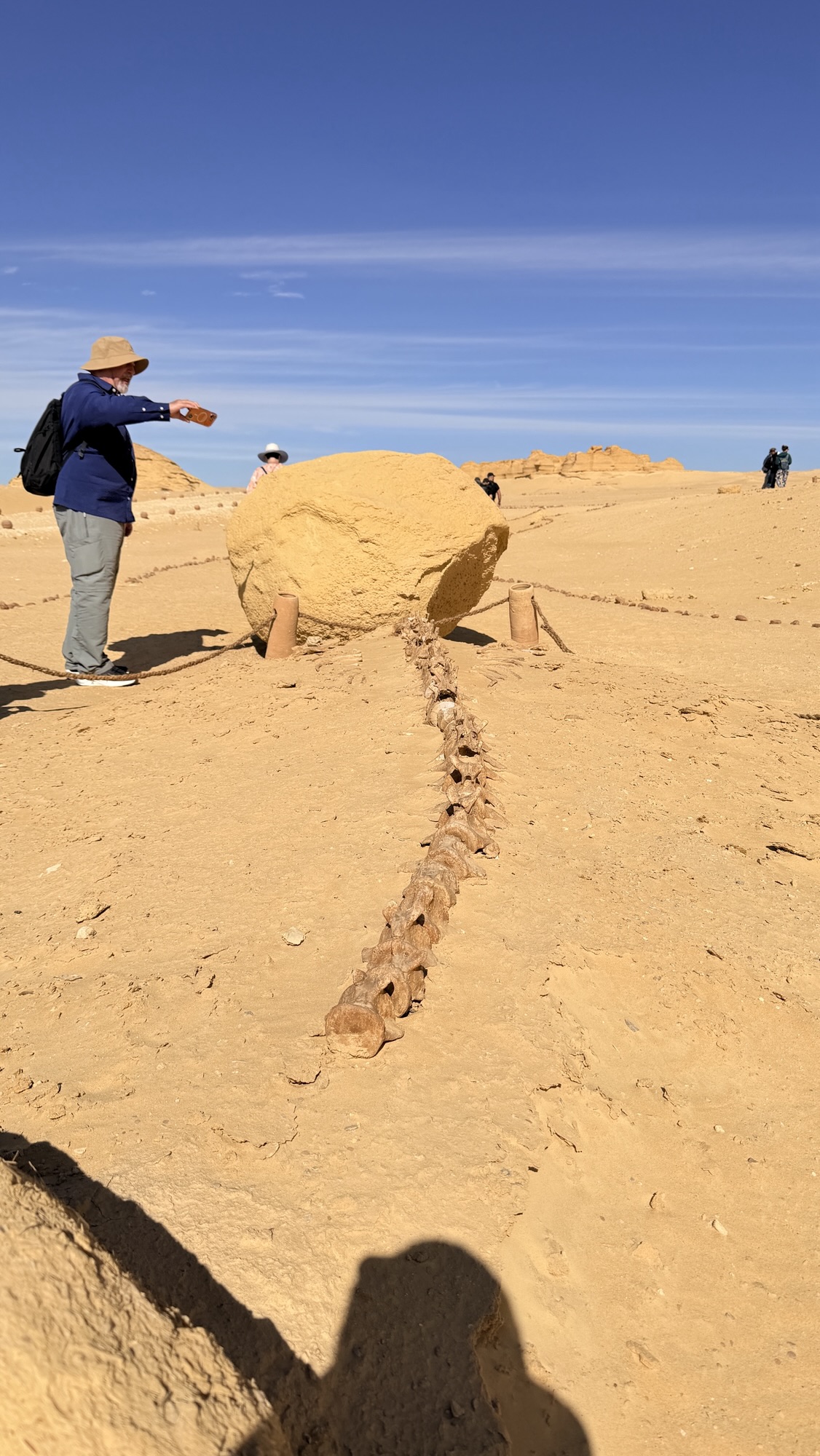
Walking among them is surreal. Skeletons lying exposed in the dunes. The sun warm, the breeze cool. History laid bare underfoot.
From there, we visited Magic Lake, a naturally occurring desert lake that shifts colour depending on the light. Then on to the Wadi El Rayan waterfalls, sometimes called Paradise Falls. A waterfall in the middle of the desert feels almost impossible, yet there it is. The area was busy, with markets and visitors, and once again, visible security presence.
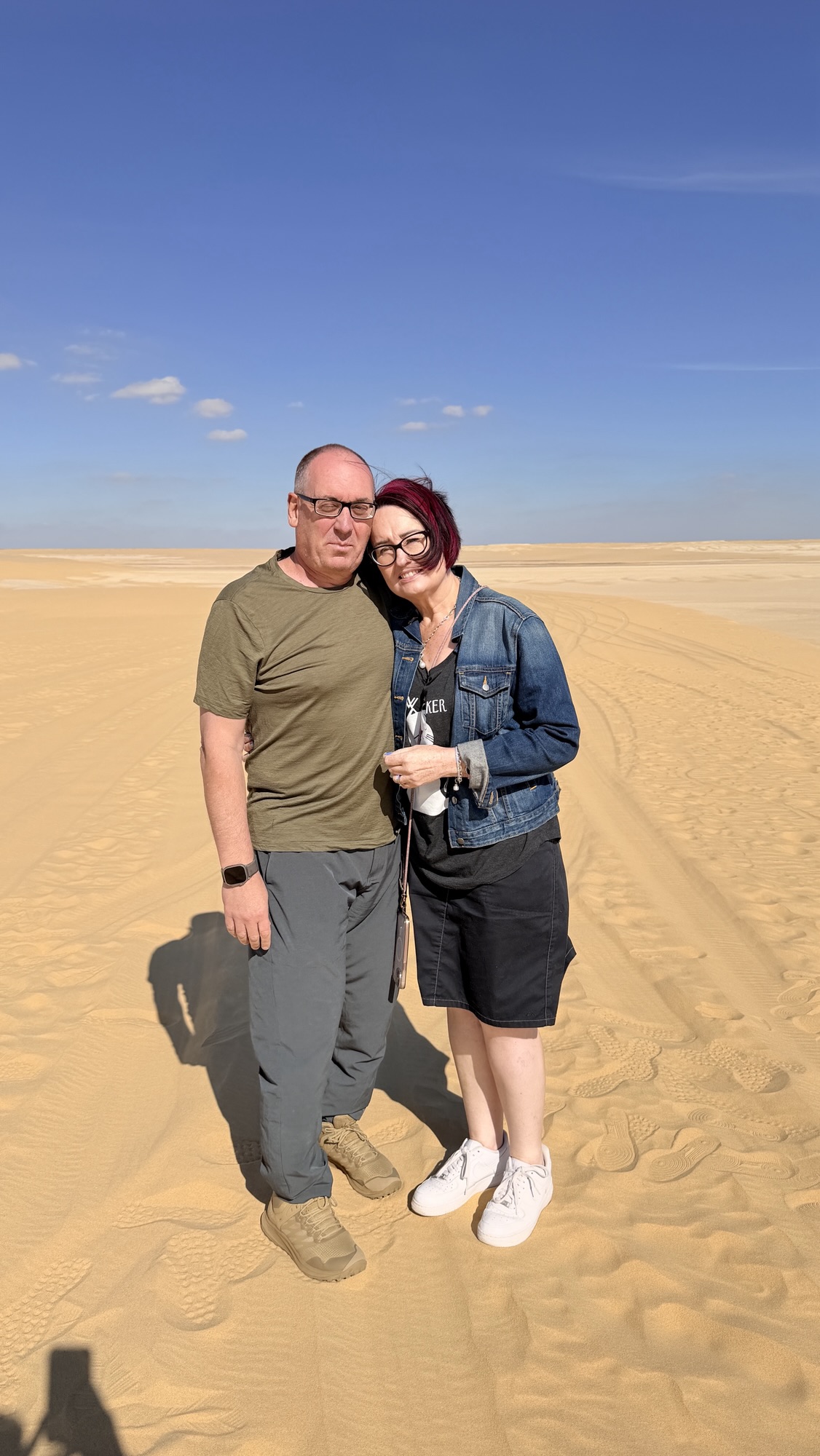


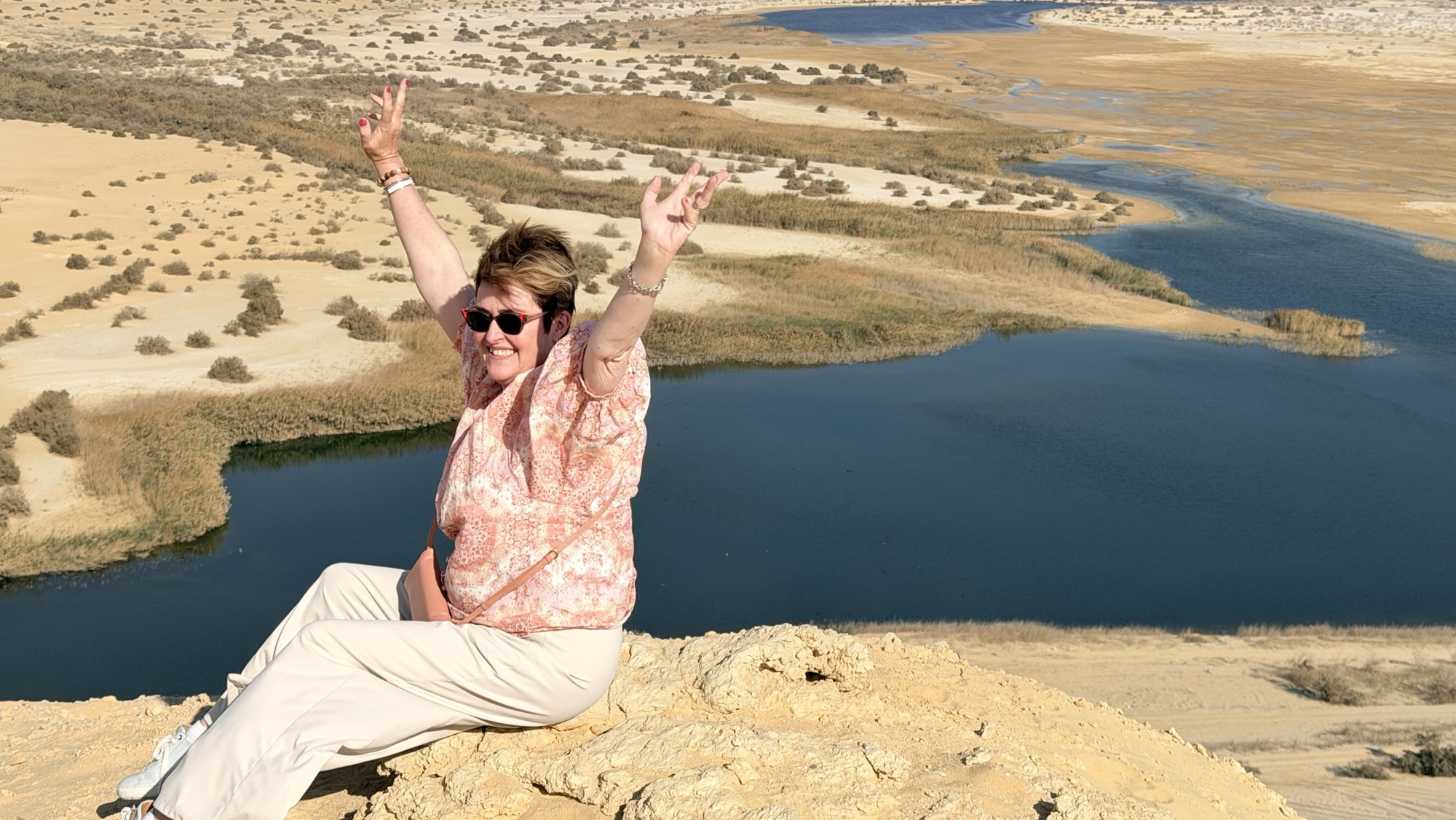

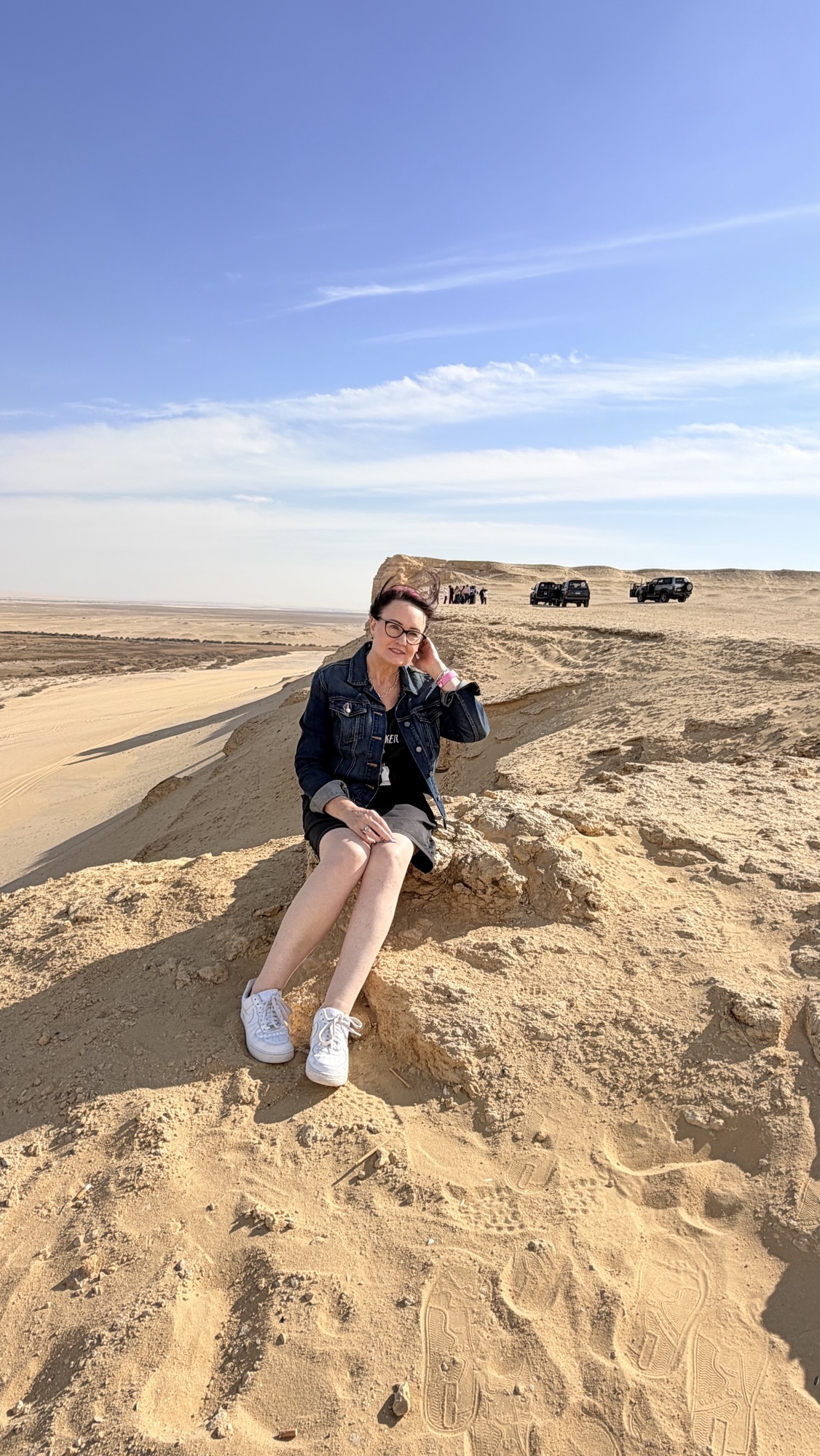
Eventually, we reached the freeway. Smooth bitumen never felt so good after hours bouncing across sand dunes.

Lunch in Tunis Village
Amira had arranged lunch at Malik Tunis, in Tunis Village, a community known for its pottery.
Lunch was classic Egyptian barbecue. Kofta, grilled chicken, rice, tahini, flatbread. Simple, fresh, and delicious. We were joined by a small army of cats hoping for scraps.
After lunch, we wandered through pottery workshops and watched an 11-year-old boy working confidently at a pottery wheel, shaping a bowl with quiet focus. Skill passed down, generation to generation.
The road home
The drive back to Giza took around two hours.
Egyptian roads defy description. As Amira explained, “The first rule of the road is there are no rules.” Traffic lights exist, but apparently more in spirit than practice. She joked that traffic lights live in your heart.
At times we were travelling at speeds well over 140–150 km/h, weaving through traffic that seemed to operate on instinct rather than instruction.
Chaotic, yes. But somehow it works.
We arrived back at the Marriott Mena House, exhausted, dusty, and completely exhilarated.
And tomorrow, we do it all again, this time to the north and the great city of Alexandria