24 January
We were docked overnight in Esna, and for the first time on this trip our cabin was dockside rather than riverside. The difference was immediate and dramatic.
At around 4.30am, the call to prayer erupted across the city. Loudspeakers burst into song and prayer, echoing from minarets in every direction. It felt as if one was mounted just outside our balcony. The chant went on for close to an hour, overlapping, drifting, receding, and returning again. We half-slept through it, drifting in and out, aware we were very much in someone else’s world.
By 6.30am, David and I were up and ready. Viking had two excursions scheduled this morning: one to a temple at 8.00am, and another walking tour of the local markets at 8.15am. David and I wanted to do both. Mardi and Kerrie were keen on the markets. So we decided to split up and David and I would head out early on our own.
Our target was the Temple of Khnum, the remarkable temple buried around 10 metres below street level.
And this is where it all went slightly sideways.
A short lesson in why you shouldn’t let me navigate
I don’t know why people haven’t learnt this yet, but you should never let me lead. I’ve been taking people to the wrong place for about 40 years, and yet David still trusted me.
“Pull out your phone, Michael,” he said.
I did. Google confidently announced the temple was a ten-minute walk away. Perfect. Off we went.
The streets were dusty and quiet. Dogs and cats wandered freely. Most shops were closed, with the odd shopkeeper sweeping dust or washing the pavement outside their door. Google told us to turn left. We did. Then right. Then straight.
We found ourselves in a narrow lane barely three metres wide, flanked by rubble, half-collapsed buildings, broken windows, and boarded-up storefronts. Then suddenly we spilled into a lively market. Motorbikes buzzed past. Minivans edged through crowds. People shouted greetings and prices. Early-morning shoppers haggled over bread, fruit, and vegetables.
Google said, “You have arrived.”
We hadn’t.
David looked up. “That’s not a temple.”
He was right. It was just… a building.
We spun around, confused. No temple in sight. I searched again, found a photo, and showed it to a local man standing nearby in traditional dress, cigarette in hand. He waved vaguely. A tuk-tuk driver appeared. Animated Arabic followed. I understood none of it.
I showed the driver the photo. He nodded. “Two dollar,” he said.
We climbed in, held on for dear life, and bounced through the streets of Esna, weaving past donkeys, horses, markets, and carts. After a few minutes, the driver stopped and pointed. We saw nothing.
Then he pointed down.
That’s when it clicked.
The temple wasn’t missing.
It was below us.
We peered over a fence and there it was: a massive temple, sunk deep into the earth, columns rising from a huge excavation like something rediscovered rather than built.
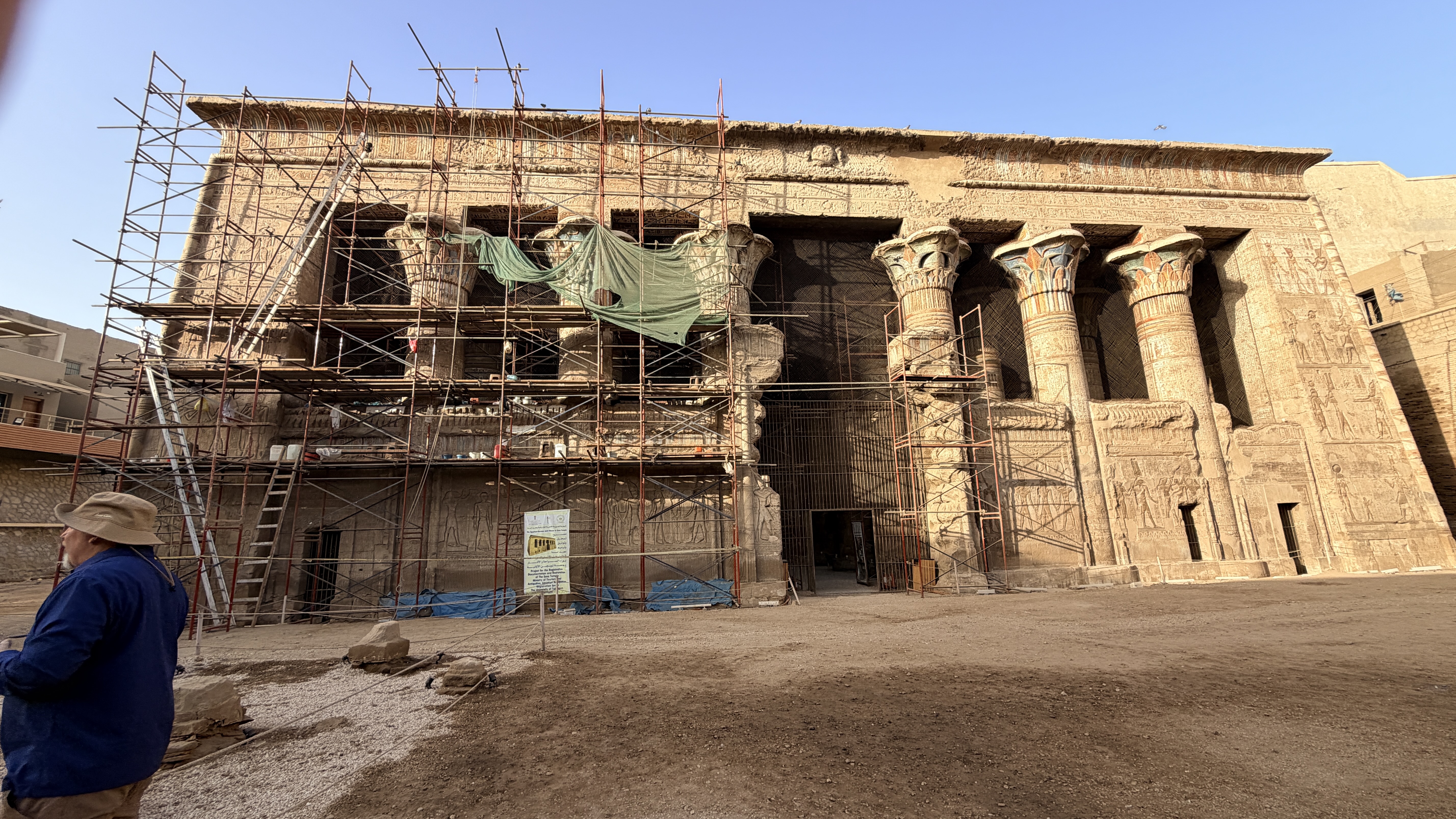
We paid the driver and tried to enter. No tickets. Of course.
We were directed back through the streets to buy tickets. After some wandering, we emerged at the end of a lane… directly opposite our ship, the Viking Aton. At the top of the gangway steps was a large sign: Tickets for Temple of Khnum →
David and I looked at each other and burst out laughing. A full circle, literally.
The Temple of Khnum
The Temple of Khnum dates mainly to the Ptolemaic period (c. 332–30 BCE), when Egypt was ruled by Greek successors of Alexander the Great, though it stands on the site of much earlier temples. Khnum, the ram-headed god worshipped here, was believed to create humans on a potter’s wheel and control the annual flooding of the Nile.
Over centuries, the surrounding city rose as debris accumulated, burying the temple almost entirely. It was only fully excavated and restored in modern times, which is why it now sits dramatically below street level.
Inside, the temple is extraordinary. Massive columns combine Egyptian and Greek architectural styles. The left side is still covered in scaffolding, with active archaeological work underway. This is a living site of discovery.

The walls and ceilings are densely decorated. Processions of gods. Animals. Serpents. Owls. Dogs. At one point David spotted what he thought was an owl-headed figure on the ceiling. Closer inspection revealed a scorpion, its body stretching across the ceiling, tail extending into a black spike. A masterpiece.
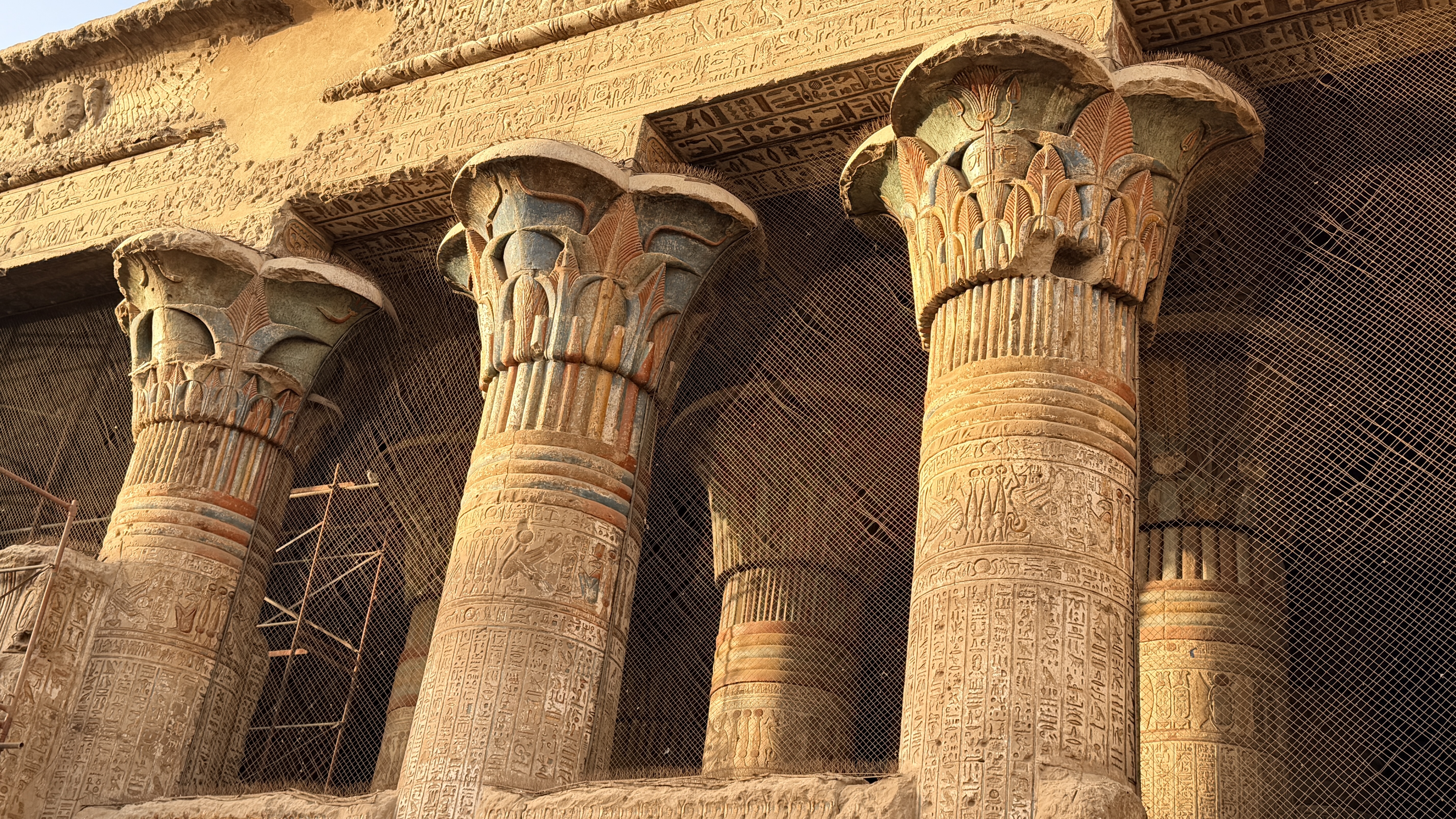
The upper walls and ceilings are in remarkable condition, colours still vivid. Lower down, centuries of erosion and vandalism have softened the carvings, a reminder of how long this temple lay hidden and exposed.
It was a magical, unexpected start to the day.

Markets, haggling, and sensory overload
We returned to the ship just in time to rejoin Mardi and Kerrie for the Esna market walking tour, led by Rasha. She explained how to haggle, what fair prices looked like, and how to shop without getting completely overwhelmed.
We passed cotton being beaten for mattresses, oil presses extracting lettuce oil, and saw galabeyas being starched and ironed. It was fascinating and very real.
Shopping, however, was intense.
Mardi wanted Egyptian cotton. Traders insisted everything was cotton. It wasn’t. Bolts of fabric were pulled out at speed. Voices rose. Space closed in. For someone neurodiverse, it quickly became overwhelming. We picked up a few items, quickened our pace, and eventually escaped.
At a pottery store, negotiations became serious. Prices started ridiculous. We walked away. Numbers dropped rapidly. In the end, US$50 for five items was agreed just as we were due back on board. Two minutes later, the gangway lifted. Perfect timing.
Hieroglyphs and the Rosetta Stone
Later that morning, Ibrahim ran a session on hieroglyphics.
Hieroglyphs began as pictorial symbols representing sounds, ideas, and objects. Over time, they evolved into a complex system combining phonetic signs, ideograms, and determinatives. A foot, for example, might represent movement or a particular sound. Language was visual, symbolic, and layered.
Much of this remained a mystery until the discovery of the Rosetta Stone in 1799 by French soldiers during Napoleon’s campaign in Egypt. The stone contains the same text written in Greek, Demotic, and hieroglyphs. Because Greek was known, scholars—most notably Jean-François Champollion—were able to finally decode hieroglyphs in 1822, unlocking ancient Egyptian history.
Without the Rosetta Stone, much of what we’ve seen would still be silent.
Sailing south
After lunch, we sailed south toward Edfu. The afternoon slowed beautifully. Children waved from the banks. Feluccas drifted past. Cattle grazed. Birds nested. The Nile carried on doing what it has done for millennia: sustaining life.
We visited the wheelhouse, met the captain, and learned how this shallow, narrow river is navigated with precision. Our ship’s draft is just 1.5 metres, in a river that can be as shallow as three metres in places.

As evening came, we attended the Viking briefing, enjoyed a traditional Egyptian dinner, and called it an early night.
Tomorrow brings Abu Simbel for David, Kerrie and I, and a gentler Aswan day and the Cataract hotel for Mardi. .

Another chapter awaits.