Our day begins early, leaving the hotel at 8.30am for what is widely regarded as one of the modern wonders of the world. Petra is an ancient city, carved directly into sandstone cliffs more than 2,000 years ago, its origins dating back to around the first century BC. Unlike the great monuments of Egypt, which were built stone by stone, Petra was sculpted out of the living rock itself. Nothing was assembled. Nothing transported. The mountain is the city.
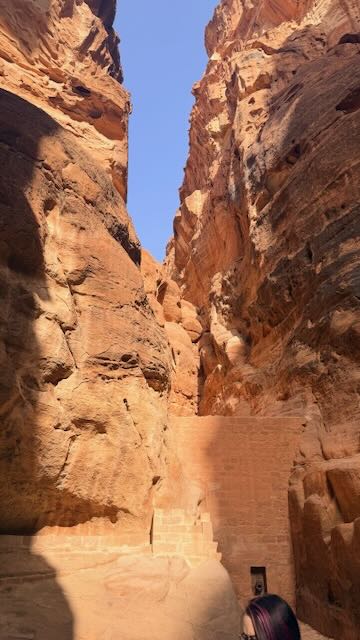
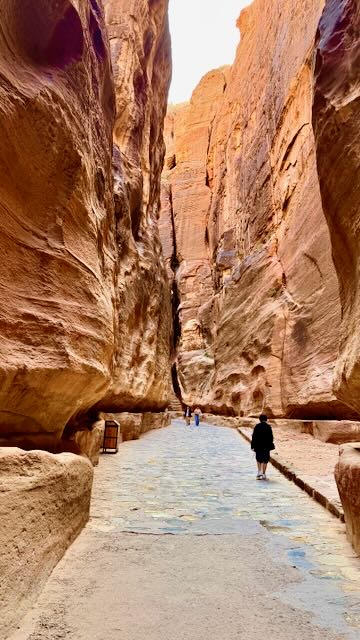
The walk in is part of the experience. The Siq is a long, narrow gorge, just over two kilometres in length, formed naturally by tectonic movement and water erosion over millennia. Towering rock walls rise on either side, sometimes narrowing to just a few metres. The stone is extraordinary. Bands of colour ripple across the cliffs, reds, ochres, purples, yellows, created by iron oxides and other minerals laid down over geological time, then polished smooth by wind and water.
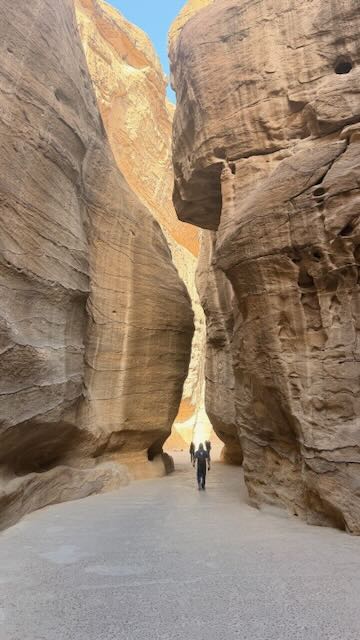
As you descend gradually, around 200 metres in total, the Siq twists and turns, revealing nothing of what lies ahead. Then suddenly, without warning, it opens into a broad courtyard and there it is, the Treasury.
Even knowing it was coming, it stops you in your tracks.
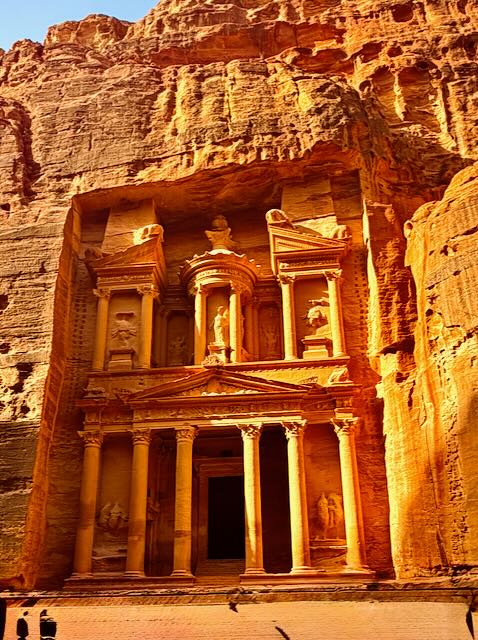
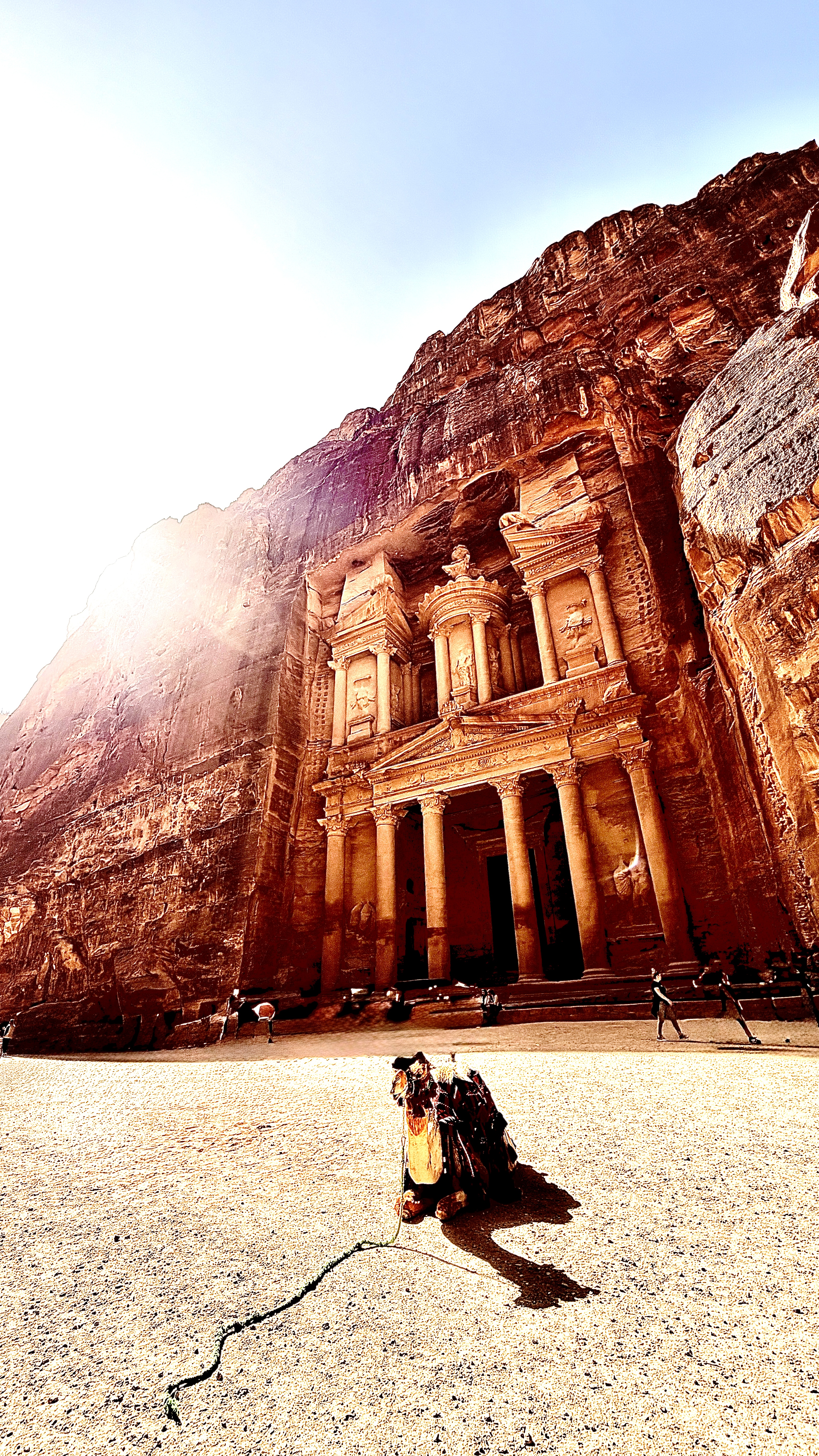
The Treasury, or Al-Khazneh, stands over 40 metres high, its ornate façade carved with astonishing precision directly into the cliff face. Columns, pediments, figures and decorative friezes emerge from the rock as if the mountain itself decided to dress up. It is widely believed to have been a royal tomb, likely for a Nabataean king, rather than an actual treasury, despite the name. The Nabataeans were a sophisticated trading civilisation who controlled vital caravan routes linking Arabia, Egypt, and the Mediterranean. Wealth flowed through here, and Petra flourished.
There are subtle influences everywhere. Egyptian motifs appear, including references to deities such as Horus. Roman design elements are also evident, reflecting Petra’s later absorption into the Roman Empire. Much of the stone pathway beneath our feet was laid by the Romans nearly 2,000 years ago, still remarkably intact.
The courtyard in front of the Treasury is alive with sound. Voices echo off the rock walls. Camels and horses shuffle past. The sun hits the sheer cliffs at sharp angles, constantly changing the colours and shadows. I stand there, quietly overwhelmed. This was carved by hand. By people not so different from us. With tools far simpler than anything we use today.
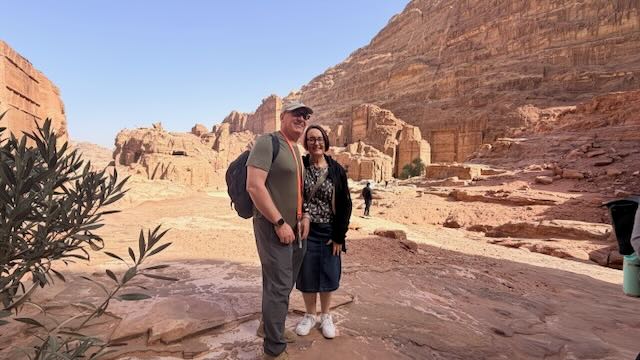
From there we continue deeper into the site, passing dozens of tombs carved into the rock walls. Some are elaborate, clearly built for elites. Others are little more than simple openings in the stone, resting places for ordinary people. Petra was not just ceremonial, it was a living city, with markets, homes, temples and burial grounds all interwoven.
The traders are ever present. Their calls of “one dinar, one dinar” echo constantly. The signs say the same. But as soon as you stop, touch, or show interest, the price becomes five, sometimes ten times that. It’s classic bait and switch. Illegal at home. Perfectly normal here.
Petra is also expensive. The Jordanian dinar is tightly pegged to the US dollar, making it one of the strongest currencies in the region. For Australians, one dinar is roughly two dollars. A five-minute golf cart ride, about 200 metres, costs 15 dinars. Thirty Australian dollars. A can of Coke can be five dollars. It’s hard to reconcile these prices with average local wages, which are closer to the equivalent of AU$800 a month.
Tourism here has taken a hit in recent years due to the broader geopolitical situation across the Middle East. There’s a sense that Jordan is competing hard for attention, particularly with Egypt. As much as I wanted to see Petra, it’s impossible not to compare. Egypt simply offers scale and depth on a different level.
Further along we reach the Roman amphitheatre, another astonishing achievement. Instead of constructing it stone by stone, the Romans carved it directly out of the hillside. Row upon row of curved seating, all hewn from solid rock, facing a central performance space below. It seated thousands. This space was used for ceremonies, public gatherings, funerals, and ritual events connected to death and the afterlife. Once again, the sheer labour involved is hard to comprehend.
After several hours and about four kilometres of walking, we reach the base of the famous staircase leading to the Monastery. Around 1,000 uneven stone steps climb steeply into the mountains. It’s roughly a two-hour return trip. We take a long, honest look at each other and decide we’re done. Instead, we sit, rest, and enjoy fresh pomegranate and orange juice, bananas, and chips. No regrets.
The walk back out is uphill, tiring, but beautiful. As the afternoon sun shifts, the colours of the rock deepen. The Siq becomes cooler, shaded, almost hushed. We pass the Treasury one final time, stopping again to take it in. The craftsmanship. The ambition. The civilisation that created this place, the Nabataeans, were traders, engineers, water-management experts, and skilled artisans. They built sophisticated dams, channels, and cisterns to survive in an unforgiving landscape. Petra existed because they understood their environment and worked with it, not against it.
We emerge around 1pm. Four and a half hours. About 12,000 steps. It feels earned.
Back at the Mövenpick Petra, Mardi and I rest in our room, balcony doors open. Warm afternoon sun streams in, tempered by a cool breeze. We’re feeling the accumulation of three intense weeks of travel. The stillness is welcome.
Later, David, Kerrie and I wander the streets while Mardi rests. Tourist shops line the road. Bottles filled with layered coloured sand forming desert scenes. We watch a Bedouin man who has been making them for 35 years. His hands move quickly, confidently, shaping scenes grain by grain without hesitation.
We buy a few gifts. Scarves. Lamps. Camel figurines. T-shirts. Mostly cheap, mostly Chinese-made, mostly overpriced.
As evening settles, we head to the Cave Bar, a bar carved directly into the rock, once a Nabataean tomb. We sit with drinks as the sun sets and the moon rises, nearly full. A cat joins us, curling up first on Mardi’s lap, then settling beside her on a cushion. It feels quietly perfect.
Dinner back at the hotel rounds out the day. Steak. Seafood. Soup. Simple and very good.
Our last night in Petra. Tomorrow we head back to Amman, our final day with Viking, and begin the long journey home. A fitting, reflective end to an extraordinary place.