Up early. 5:00 am.
We were asleep almost as soon as our heads hit the pillow last night. Yesterday was a big one. Six hours of travel, from the Great Pyramid to 30-million-year-old whale fossils in the desert. We rolled back into the hotel around 5:30 pm and barely made it to 8:00 before conceding defeat. No dinner. Not even a snack. Too tired to eat.
So it was an early breakfast and then back on the road.
At 7:30 am, we left the hotel and met Mo, our guide for the day. Today’s plan was ambitious. A long drive north to Alexandria, Egypt’s Mediterranean jewel.
Ten minutes in, we stopped dead.
The freeway north was closed due to fog. Thick, low, stubborn fog. We pulled into a lay-by and waited. Coffee appeared. Turkish. Dark. Gritty. Comforting. Mo indicated it would be about 30 minutes, but its weather, no one really knew how long we’d be delayed.
Ninety minutes later, the road reopened.
When we go, we really go.
Seatbelts on. A urgent warning. A hard merge across four or five lanes. And suddenly we were flying north, weaving confidently through traffic at speeds that would make an Australian highway patrol officer faint. Our driver was superb. Calm, precise, fearless.
Two hours later, we were in Alexandria.
Cairo to Alexandria: the working heart of Egypt
The drive north tells you a lot about Egypt.
Leaving Cairo, the city thins out and the land opens into the Nile Delta, one of the most fertile regions in the world. This is where the Nile fans out before meeting the Mediterranean, depositing rich silt that has sustained agriculture for thousands of years.
We passed endless fields of crops, irrigation canals, small villages, factories, warehouses, and workshops. This is Egypt at work. Not the Egypt of postcards, but the Egypt that feeds, builds, manufactures, and exports. The Delta is crowded, busy, productive, and utterly essential to the country’s survival.
Then, suddenly, the air changed.
We smelled the sea.
Alexandria: a city built on ambition
Alexandria was founded in 331 BCE by Alexander the Great, who envisioned a city that would link Greece, Egypt, Africa, and the wider Mediterranean world. Under the Ptolemies, it became one of the greatest cities of the ancient world. A centre of learning, trade, science, and culture.
For centuries, Alexandria rivalled Rome.
After the Roman period, the city became an important centre of early Christianity. Then, in 641 CE, it fell to Muslim Arab forces. Over time, Alexandria transitioned from Christian rule to Islamic rule, shaping the city you see today. Layers upon layers of history, stacked like sediment.
The Catacombs of Kom El Shoqafa
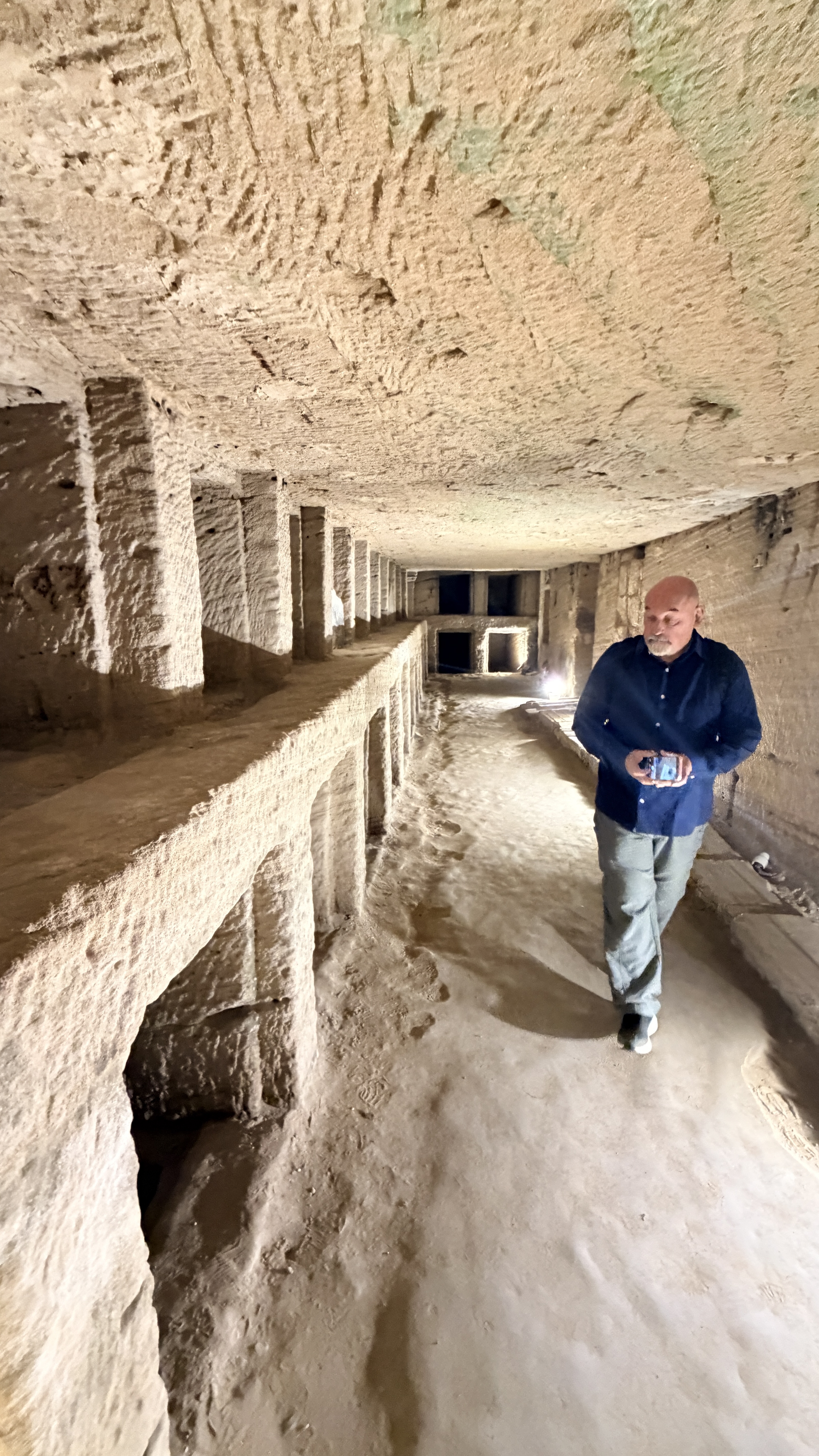
Our first stop was the Catacombs of Kom El Shoqafa, discovered accidentally in 1900 when a donkey fell through the ground.
These catacombs date to the 2nd century CE and are a fascinating blend of Egyptian, Greek, and Roman burial traditions. Carved deep into the bedrock, they were used as a communal burial site. Statues, carvings, and tombs combine Egyptian religious symbolism with Roman architectural styles.

It’s cool underground. Quiet. Slightly eerie. You can feel the cultural blending that defined Alexandria during its Roman period.
Pompey’s Pillar (and why it isn’t Pompey’s)
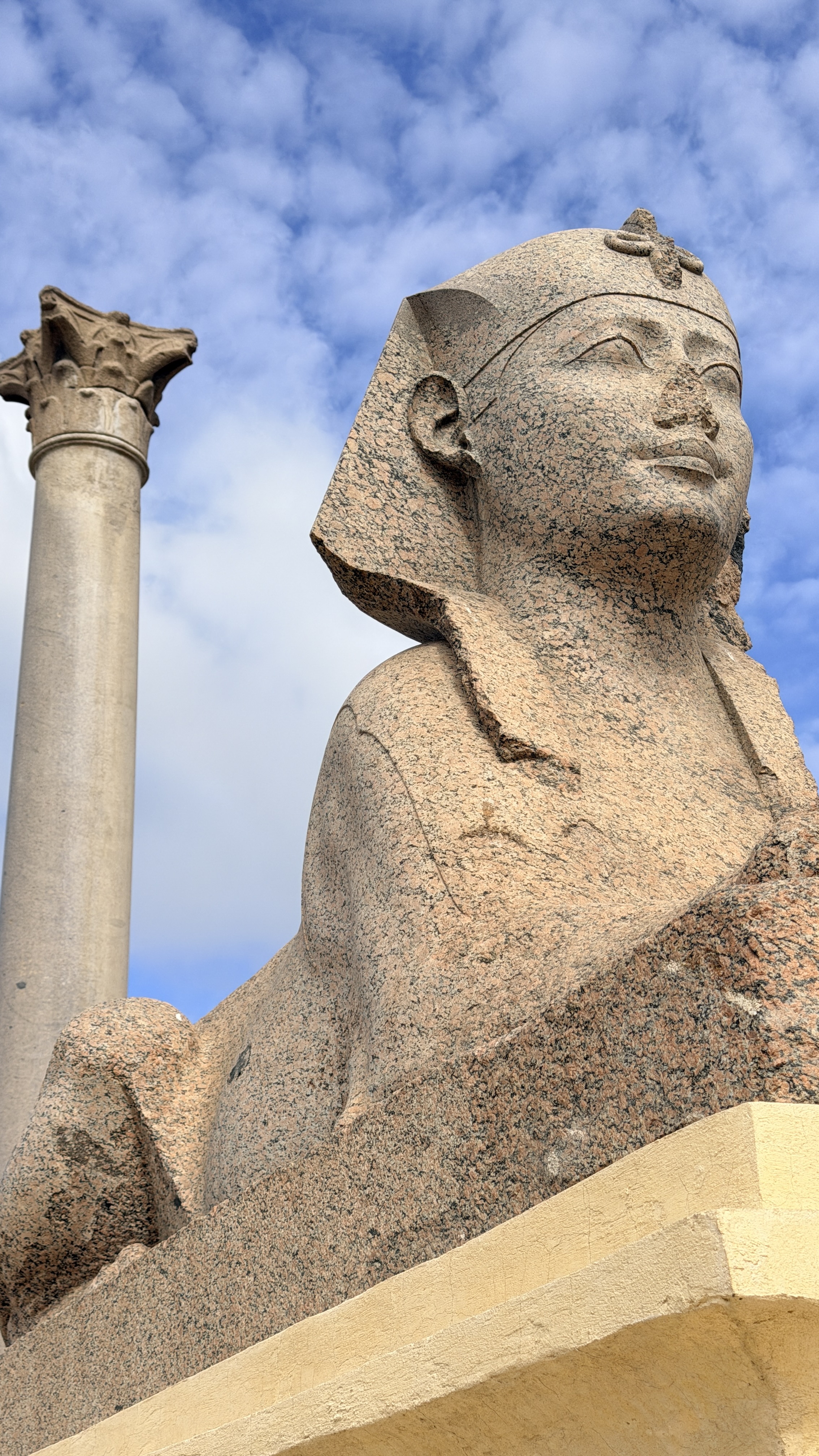
Next stop: Pompey’s Pillar.
Despite the name, the pillar has nothing to do with Pompey the Great. It was erected around 297 CE in honour of Emperor Diocletian, celebrating his victory and his role in restoring order to Egypt.
The name “Pompey” likely came from a medieval misinterpretation. Locals believed the head of Pompey was buried beneath it. There’s no evidence of that, but the name stuck.
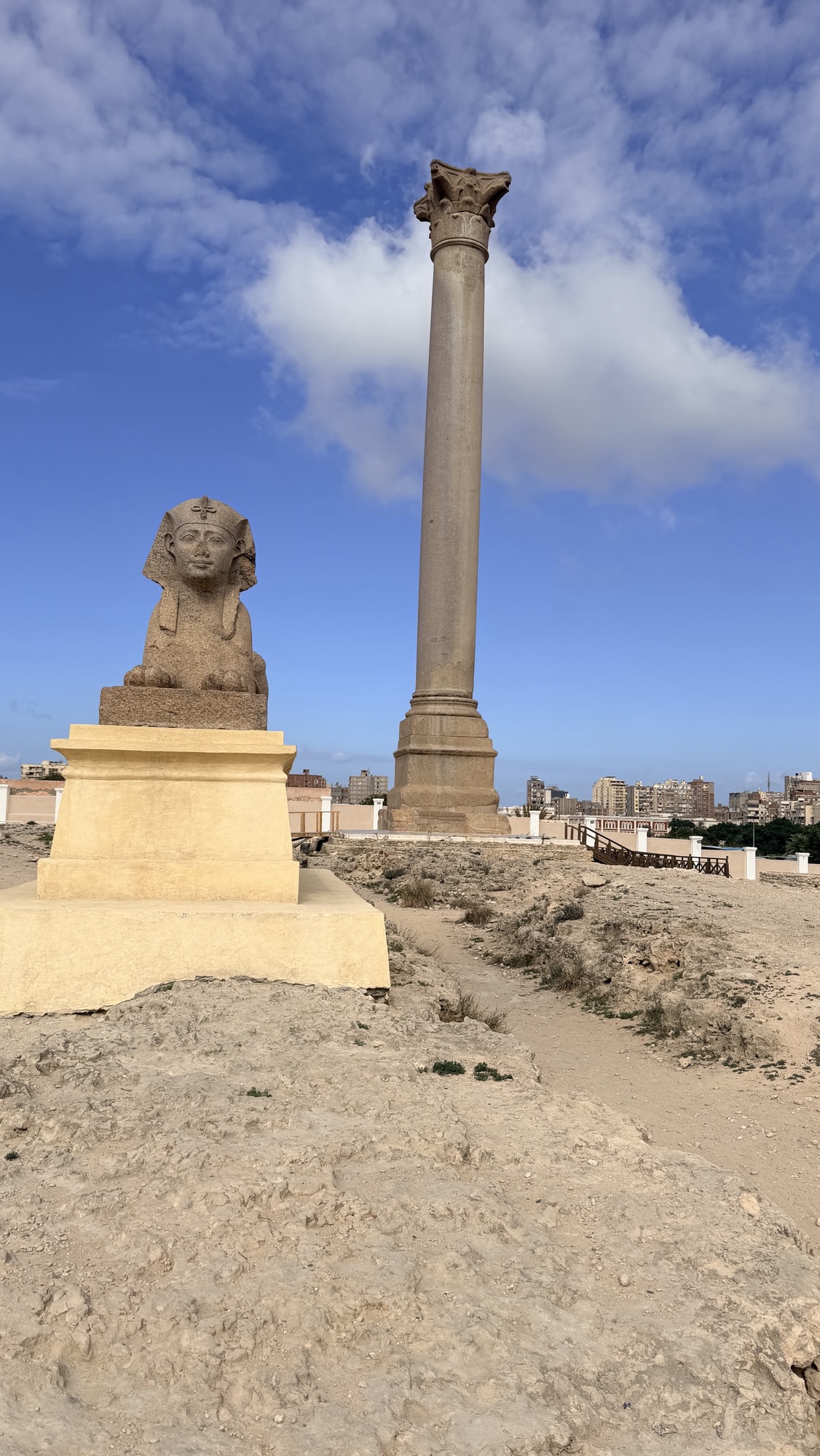
Nearby stands a sphinx, again reinforcing how Alexandria constantly blends Egyptian forms with Roman ideas.
The pillar itself is enormous. A single piece of red granite quarried from Aswan. A reminder of the sheer engineering ambition of the Roman world.
The Roman Amphitheatre
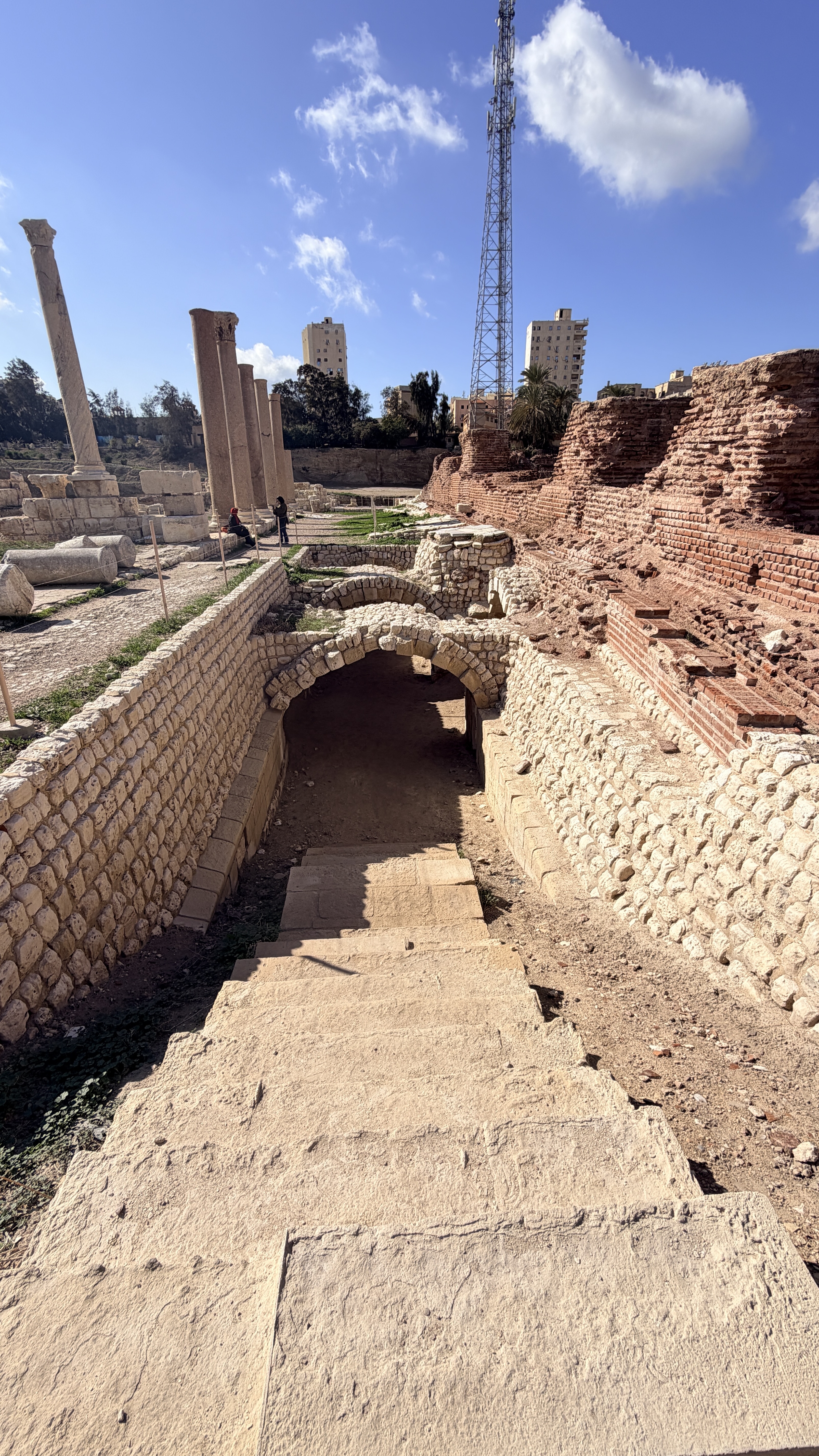
We then visited the Roman Amphitheatre of Kom El-Dikka, discovered in the 1960s.
This is the only known Roman amphitheatre in Egypt. Built in the 4th century CE, it was used for musical performances, public gatherings, and civic events. The marble seating, arranged in a semi-circle, is remarkably well preserved.

Standing there, it’s easy to imagine audiences gathering, voices echoing, performances unfolding under the open sky.
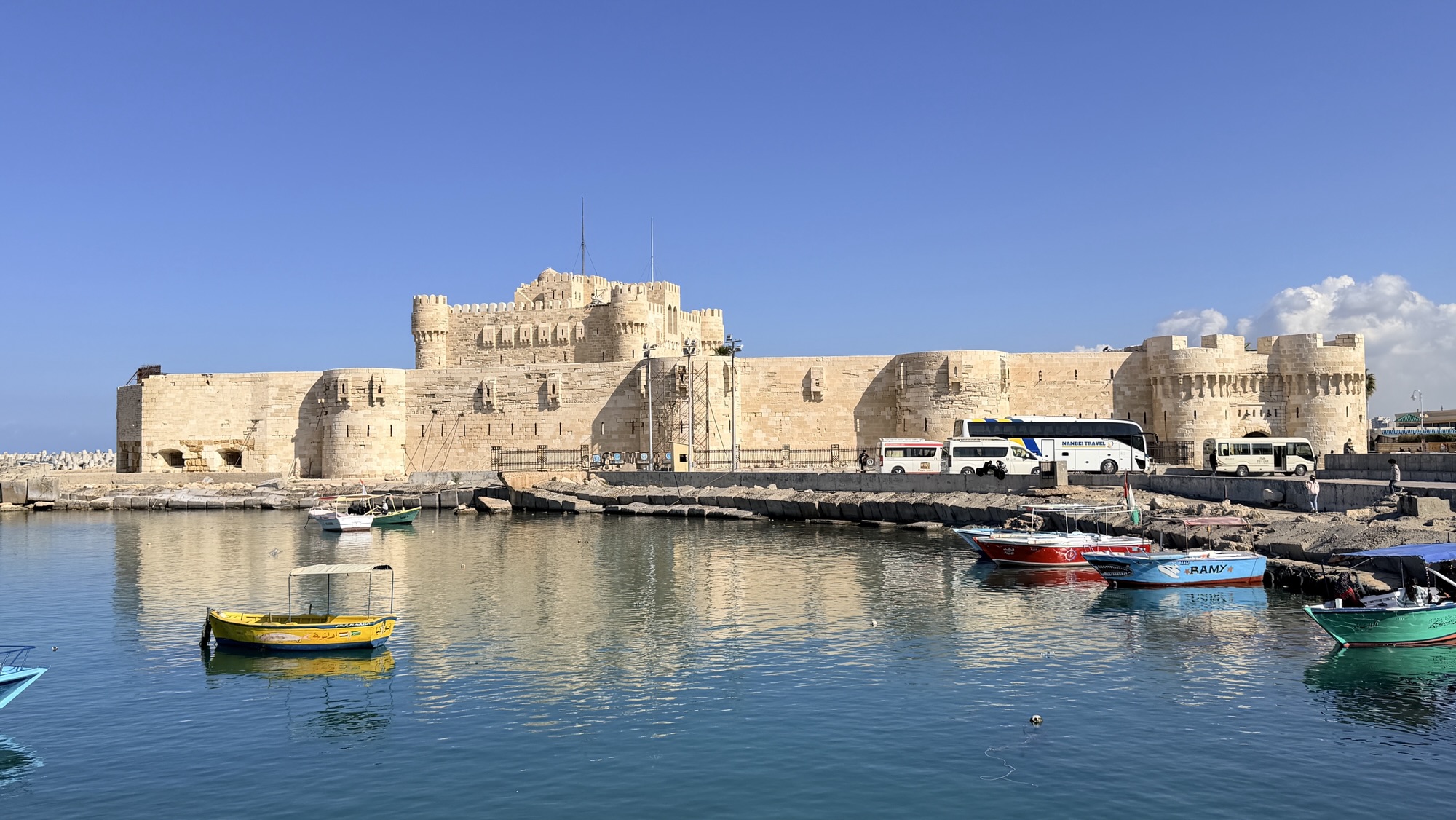
Next, the Citadel of Qaitbay.
This fortress was built in the 15th century on the exact site of the Pharos of Alexandria, one of the Seven Wonders of the Ancient World. The lighthouse guided ships safely into Alexandria’s harbour for over a thousand years before earthquakes finally destroyed it.
Much of the lighthouse stone was reused to build the citadel. The structure you see today is medieval, but it stands on foundations that once supported one of humanity’s greatest architectural achievements.
Standing on the walls, looking out over the Mediterranean, you feel the importance of this place. A gateway between worlds.
The Great Library: lost, but never forgotten
We then visited the site of the Great Library of Alexandria.
The ancient library was established in the 3rd century BCE and aimed to collect all the knowledge of the known world. Scholars came from everywhere. Works were copied, translated, debated.
Its destruction is still debated. It wasn’t a single fire, but a series of events over centuries, including damage during Julius Caesar’s time and later decline. By late antiquity, it was gone.
The modern Bibliotheca Alexandrina now stands nearby, a tribute to the spirit of inquiry that once defined the city.
Lunch by the sea
After a full morning of history, we slowed things down.
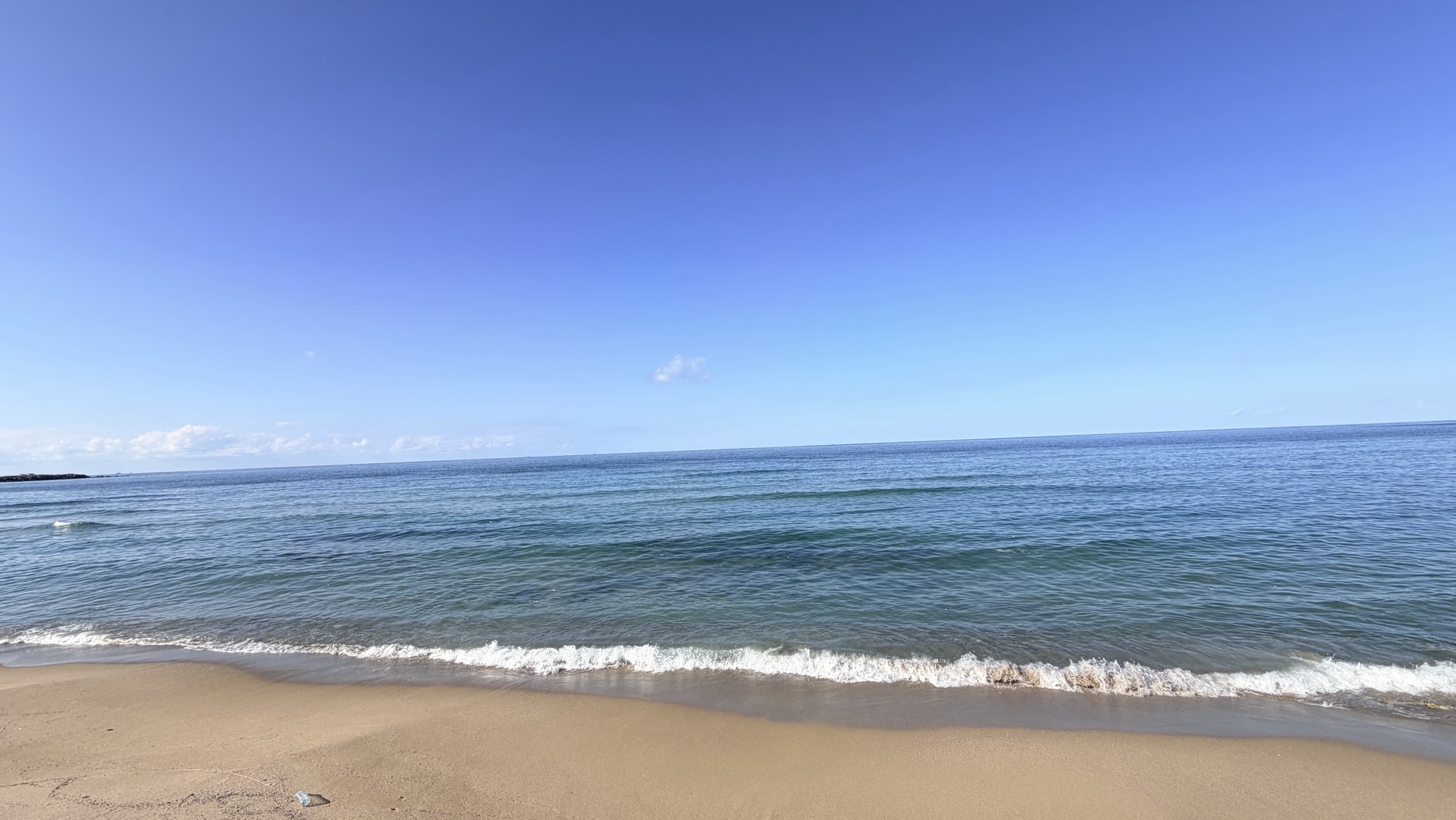
Lunch was at a seaside restaurant called Branzino, overlooking the Mediterranean. Kids played along the breakwater. Couples walked the promenade. People fished from the rocks. Snorkellers searched for crabs, shellfish, and sea urchins.
It was calm. Ordinary. Beautiful.
After the intensity of the morning, it was the perfect pause.
The fast road home
Then it was time to head back to Cairo.


The minivan barely dropped below 160 km/h. We wove, swerved, and surged south. Checkpoints and radar speed traps were the only things slowing us down.
By 5:00 pm, we were back at the hotel. Tired. Dusty. Happy.
Another day of peeling back the layers of Egypt. Another reminder that this country doesn’t just tell its story. It reveals it, slowly, one civilisation at a time.
Tomorrow, more to come. Who knows what secrets will be revealed tomorrow.